MEMPHIS, TN, August 24, 2026 /24-7PressRelease/ — The headline reads: United Nations Day October 24th 2026 Black Memphis Community Orange Mound in Memphis advance Kenya, Kennedy, King, Obama via launch of “Tom Mboya Legacy District” & Untold Civil Rights History. The African Cultural Embassy in the Historic Black Memphis Community of Orange Mound shares the webpage from the John F. Kennedy Library and Museum titled: John F. Kennedy and the Student Airlift and American Education for African Students.
Click here to view the Webpage on the John F. Kennedy Library & Museum website
On October 24, 1945 the United Nations was founded. The core Purpose of the United Nations is to maintain international peace and security, protect human rights, and foster global cooperation. The historic Global cooperation between Kenya and Black America has been erased and marginalized in both Kenya and the U.S.
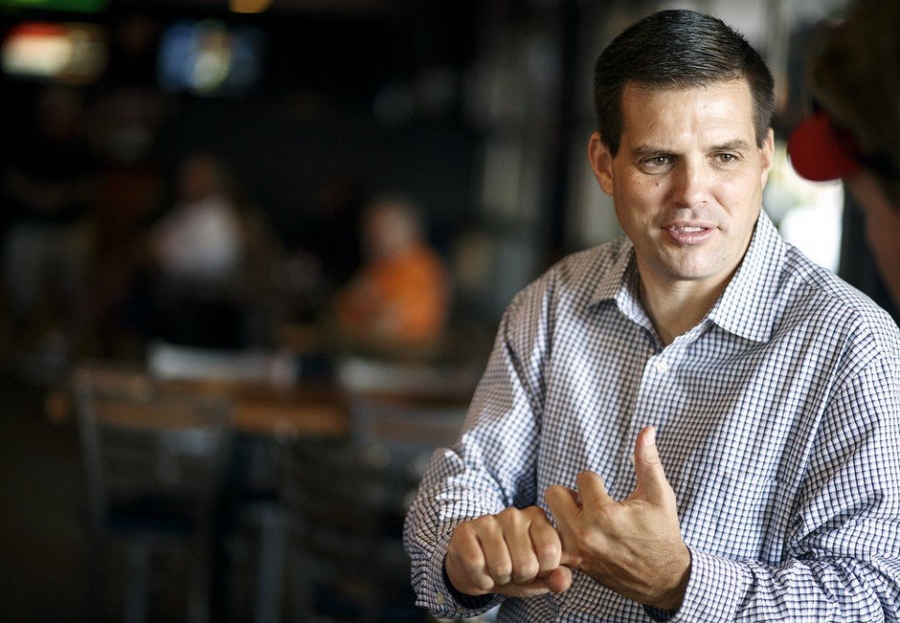
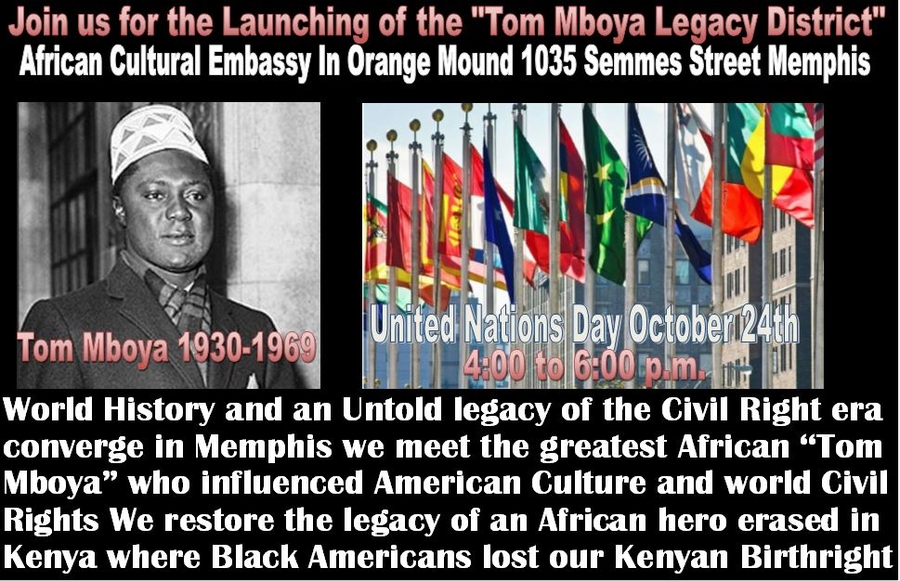
Via United Nations Day October 24, 2026 Anthony “Amp” Elmore officially launch “The Tom Mboya Legacy District” at the African Cultural Embassy in Orange Mound.
Click here to visit the website titled: Tom Mboya Legacy District. Com.
Read for yourself the grave betrayal of the Kenyan Government against both Kenyan and American Citizens a horrendous practice of erasing the historical ties of American and Black Americans in relationship to the birth of Kenya. This American erasure was implemented by Kenyan President Jomo Kenyatta and is maintained via the Kenyan Governments since the Murder of Tom Mboya in 1969.
Anthony “Amp” Elmore a Memphis born five time world Kickboxing champion notes that we African/American have our own problems in addition to Kenya, whereas on his 1st day in office American President Donald J. Trump erased DEI or Diversity, Equity and whereas Kenya erased America’s role in the birth of Kenya.
The establishment of the Tom Mboya Legacy District in the Memphis Black Orange Mound, community is not merely a local commemorative effort; it is a global forensic reclamation that positions this historic community as the absolute epicenter of the international Civil Rights Movement. This district serves as the “Primary Receipt” for a history that has been systematically erased by both American and Kenyan political establishments. It honors a time when the soil of Orange Mound and the spirit of Nairobi were inextricably linked through the labor and vision of the “Architects of Freedom.”
The importance of this district lies in its proof that the Birth of Kenya was a crowning achievement of the American Civil Rights Movement. It documents the radical mentorship of A. Philip Randolph, who served as Mboya’s “Godfather” and secured a $35,000 check from the AFL-CIO to build a Union Hall in British East Africa (now known as Kenya) and it highlights the strategic genius of Bayard Rustin and George Houser of the American Committee on Africa (ACOA), the very men who founded the Congress of Racial Equality (CORE) and engineered the 1963 March on Washington where Dr. Martin Luther King Jr. made his iconic “I have a dream speech.”
By naming this area Tom Mboya Legacy District, Orange Mound claims the legacy of Tom Mboya. Tom Mboya who was introduced to singer Harry Belafonte via Paul Robeson and Eleanor Roosevelt. Tom Mboya marched shoulder-to-shoulder with Dr. Martin Luther King Jr. and in 1959 Dr. King and the SCLC gave Tom Mboya an “African Freedom Dinner money fund raiser “ from the Southern Christian Leadership Conference on May 13, 1959.
The significance of the Tom Mboya Legacy District extends deep into the halls of American presidential power and judicial history, proving that the Kenyan modern political landscape was shaped by this Kenyan-American kinship. It is here that we preserve the record of how John F. Kennedy utilized his association with Tom Mboya to secure the crucial Black vote in 1960—a debt the Kennedy Library explicitly credits to the Kenyan leader Tom Mboya.
This district also honors the legal brilliance of Thurgood Marshall, who traveled to London to draft Kenya’s Bill of Rights and Constitution, effectively exporting the American struggle for equality to the African continent. It is the place where the world must remember the October 1964 meeting of Malcolm X and a young John Lewis at the New Stanley Hotel in Nairobi in October 1964, a moment of global Black unity that the history books have “whited-out” whereas Anthony “Amp” Elmore had a news conference at the Stanley Hotel 30 years later via an effort to unite Africans and African/Americans via introducing Kickboxing in Kenya.
Most importantly, the district serves as the forensic ground for the Airlift America project, which brought Barack Obama Sr. to the United States in 1959, making Orange Mound the symbolic guardian of the very lineage that produced the 44th President of the United States.
On August 28, 1963 Dr. Martin Luther King delivered his iconic “I have a Dream Speech” 63 years ago whereas just 3 month after the “I have a dream speech” President Kennedy was assassinated on November 22, 1963, whereas 20 days later on December 12, 1963 Kenya became an Independent Nation.
Fast forward to the upcoming October 24, 2026 of the scheduled official launching of the “Tom Mboya Legacy District” in the historic African/American Community of Orange Mound at the “African Cultural Embassy.”
The intersection of Dr. Martin Luther King, John F. Kennedy, Kenya, and Tom Mboya the Civil Rights movement Black history and world events while unknown and unrelated to most this history interspersed in Orange Mound at the African Cultural Embassy.
In 1986 filmmaker Spike Lee premiered a Black and White film titled “She Gotta have it.” Anthony “Amp” Elmore a Memphis born 5-Time world Kickboxing was the 1st to bring E.S.P. N. to Memphis in 1981. Ten year earlier Elmore lead the 1st 18 year old voter registration in the State of Tennessee whereas Elmore was a part of “Black Movement in America” whereas he sported a large Afro and adopted African culture via an African name whereas in 1972 being student at freshman student at then Memphis State College quit college joined a movement called “M.A.N.” (Making a Nation) headed by the Rev. James Bevel the Chief Strategist of the S.C.L.C. and confidant of Dr. Martin Luther King.
Elmore would become a delegate at the 1st Black political Convention in Gary, Indiana open his own business and purchase his 1st Home in Orange Mound in 1972. At 19 years old Anthony “Amp” Elmore became a part of the “New Age Movement;” Black Power, Eastern Philosophy, Buddhism, Meditation Yoga and Martial arts.
Fast forward to East African Country of Kenya whereas one has to look no further than to American magazines to get a true, historical and untold story of Kenya and its relationship to America and Americans.
Click here to view the March 7, 1960 issue of Time Magazine titled: “Kenya’s Tom Mboya.”
The question should be asked: Why would Time Magazine the World’s premier American magazine put Tom Mboya an African on its cover. Time framed Tom Mboya as the indispensable leader bridging the gap—championing Kenyatta’s release while demonstrating the administrative poise, constitutional discipline, and international diplomacy needed to govern a modern republic.
Time put Tom Mboya on the cover because he was the face of the decolonization revolution: a labor leader and diplomat who connected African liberation directly to American civil rights, international trade unions, and global statecraft.
The most important element of the March 7, 1960 Time Magazine article is the fact that Tom Mboya a labor leader and diplomat connected African liberation directly to the Civil Rights movement.
The history of Kenya’s independence cannot be honestly told without recognizing how deeply it is intertwined with Black America and the broader Civil Rights struggle, yet that very connection has been pushed to the margins in Kenya’s official narrative. In the late 1950s and early 1960s, Tom Mboya emerged as a brilliant labor leader and architect of Kenya’s future, and he did something extraordinary: he turned to African Americans and sympathetic allies in the United States to help educate a generation of East African students.
Through the African American Students Foundation, with support from figures like Jackie Robinson, Harry Belafonte, Sidney Poitier, and others, hundreds of Kenyan and East African students were brought to American universities. Senator John F. Kennedy, through the Kennedy Foundation, stepped in when the U.S. State Department refused, funding the 1960 airlift and making it possible for those students to travel to America for education.
Among the beneficiaries of this movement was Barack Obama Sr., whose journey to the University of Hawaii was inspired by the airlift and supported in part by funds connected to this African American effort. This is not speculation; it is documented in the John F. Kennedy Presidential Library. It shows that Black Americans and sympathetic Americans played a direct, material role in the birth of Kenya’s educated leadership class and, by extension, in the shaping of Kenya’s independence.
Yet, as Kenya moved into its post-independence era under President Jomo Kenyatta, this crucial chapter of history was not elevated, celebrated, or taught as a central part of the national story. Tom Mboya, who had been widely expected to become a future leader of the nation, was assassinated July 5, 1969, and over time his legacy was diminished in public memory. The role of African Americans in funding and supporting Kenyan education, the partnership between Mboya and Kennedy, and the connection between Kenya’s independence and the American Civil Rights Movement were not woven into the mainstream narrative taught in schools or promoted in national identity. In fact Tom Mboya’s role between Kenya and America was “Erased.”
Instead, Kenya’s story was often framed primarily through internal nationalist struggle and colonial resistance, with little emphasis on the transatlantic Black solidarity that helped make its future possible. Anthony “Amp” notes that erasure feels like a betrayal: Black America extended its hand, invested its resources, and helped build Kenya’s future, yet Kenya has not consistently acknowledged that contribution or embraced African Americans as kin in its official story.
This sense of betrayal is intensified when we look at Kenya’s modern relationship to tourism and global image. For over a century, Kenya has been marketed as a luxury destination for wealthy White Western travelers, with safaris, resorts, and high-end experiences often tailored to white visitors from Europe and North America.
At the same time, African Americans—who now possess an estimated $2.3 trillion in buying power and spend more on leisure travel than Kenya’s entire GDP—have not been systematically invited, courted, or recognized as a core audience rooted in shared history. While individual African Americans do visit Kenya and some Kenyans deeply value these connections, there has been no sustained, formal national campaign that says: “Our independence is tied to your struggle. Our history is tied to your activism. You helped educate our leaders. African/American have not been formally invited to Kenya and noted as family to Africans.
Anthony “Amp” Elmore explains via the “Charter of Kinship” how Tom Mboya Education, Culture and Entertainment center can change the fortunes of Kenya, whereas in Kenya this would be the largest such center in the world that would bring billions and billions to not only Kenya but such would bring wealth to Africa.
Tom Mboya’s erasure is at the heart of this wound. When his story is not taught, when his partnership with African Americans and JFK is not widely known, when his assassination is not framed within the larger context of what was lost, Kenya loses more than a name—it loses a bridge. That bridge connected Kenya to Black America, to the Civil Rights Movement, to a shared vision of Black liberation across continents.
By Kenya failing to fully honor Tom Mboya and the transatlantic network that supported him, Kenya unintentionally distances itself from Black America and from a powerful source of solidarity, investment, and cultural exchange. The Anthony “Amp” Elmore’s work—through the Tom Mboya Legacy District in Orange Mound, through decades of engagement with Kenya—is an attempt to repair that bridge.
October 24, 2026 is United Nations Day whereas from October 18th to the 24th is United Nations week whereas Anthony “Amp” Elmore mention to Cherokee School Principal Tina Smith that Cherokee Elementary School in Orange Mound lead the nation in celebrating “United Nations Day” whereas Cherokee Elementary School partner with Arya Primary School in Kenya to celebrate the “Tom Mboya Legacy District” in Orange Mound.
Anthony “Amp” Elmore explains I was 10 years old when President John F. Kennedy was killed 63 years ago on November 22, 1963, however it was August 28, 1963 when Dr. Martin Luther King gave his iconic “I have a Dream Speech” wherein just 20 days after the death of President Kennedy Kenya became a nation on December 12, 1963.
Anthony “Amp” Elmore created the “African Cultural Diplomat Exchange Network” whereas Anthony “Amp” Elmore notes that at 10 years old he lived through the pain of America mourning the death of a beloved President wherein 63 years later he has a 10 year old son and others who can honor Dr. Martin Luther King, President Kennedy, America, Kenya, President Obama as “Cultural Diplomats.”
On October 25th 2024 Arya Primary School in Kisumu, Kenya looked to name their Class after Anthony “Amp” Elmore. Elmore declined and suggested the school name their class after Memphis Congressman Steve Cohen.
Click here to see the video titled: Steve Cohen Center of Cultural Diplomacy
Cultural diplomacy relates to the United Nations because the UN was founded on the idea that peace, cooperation, and human development cannot be achieved by governments alone; they require cultural understanding between peoples. Cultural diplomacy is the practice of nations, communities, and institutions using culture, education, shared history, and human connection to build relationships across borders.
When schools, cities, or cultural institutions exchange students, share history, or celebrate each other’s heritage, they are participating in the same principles the United Nations was created to promote. The UN Charter emphasizes international cooperation, respect among nations, and the advancement of education and cultural exchange as tools to prevent conflict and strengthen global unity. Cultural diplomacy is therefore not a side activity—it is one of the core missions of the United Nations system.
The launching of the Tom Mboya Legacy district October 24, 2026, connects directly to these United Nations principles because the launching the Tom Mboya Legacy District as a cultural bridge between Memphis and Kenya. By linking Cherokee Elementary School in Memphis with Arya Primary School in Kisumu, Kenya, Anthony “Amp” Elmore notes; we are creating a real, living example of cultural diplomacy: children learning each other’s history, communities recognizing shared heritage, and two nations connecting through education rather than politics.
This is exactly the kind of grassroots international cooperation the United Nations encourages. The fact that Tom Mboya himself spoke before the United Nations and represented Kenya on the world stage makes the Tom Mboya legacy District celebration even more aligned with UN values. Tom Mboya’s work with John F. Kennedy, African American leaders, and the Airlift students was itself a form of cultural diplomacy—bringing young Africans to America to learn, grow, and return home as leaders.
Launching the Tom Mboya Legacy District on United Nations Day, October 24, gives Orange Mound and the participants a global legitimacy because they are framing this work within the UN’s mission of peace, education, and international cooperation. This news story dated August 24, 2026 celebration becomes the beginning of a 60-day journey toward a global diplomatic moment.
Cultural diplomacy connects all of these entities because it is one of the core principles of the United Nations: the idea that peace, cooperation, and global understanding are built not only through governments, but through relationships between communities, schools, cultural institutions, and people. When the Tom Mboya Legacy District is launched on United Nations Day, it symbolizes that the history linking Kenya and African Americans is not just national history—it is international history that fits directly within the UN mission of education, cultural exchange, and human development.
The launch of the Tom Mboya Legacy District on United Nations Day, October 24, 2026, calls upon the support and historical alignment of Memphis Congressman Steve Cohen, whose role elevates this movement from a community celebration to a national and international moment of recognition. In a digital world where history, culture, and truth can finally be shared without gatekeepers, the “African Cultural Diplomat Exchange Network” stands as a new model for global Black engagement — a system designed to create “Cultural Diplomats” who carry the legacy of African and African American unity into the future.
On October 25, 2024, students in Kisumu, Kenya launched the “Arya Steve Cohen Center for Cultural Diplomacy,” connecting Arya Primary School with Cherokee Elementary School in Orange Mound. This connection between Memphis and Kisumu, between African American children and Kenyan children, becomes the foundation of a new era in African/American and African history — an era we call “Kinship Diplomacy.”
When Congressman Cohen takes one minute on the floor of the United States Congress to acknowledge this movement, he re-ignites the Tom Mboya story in the American and global space. His words enter the Federal Record, creating a permanent historical alignment that allows schools, historians, educators, and future generations to revisit the documented truth preserved in the John F. Kennedy Presidential Library.
Tom Mboya’s leadership, mentorship, and partnership with African Americans helped shape the Civil Rights Movement, influenced President John F. Kennedy, and laid the foundation for the educational airlift that made possible the rise of Barack Obama Sr. and ultimately the presidency of Barack Obama Jr. Congressman Cohen’s recognition becomes the spark that reopens this erased chapter of history, allowing America to rediscover the alliance between Africa and Black America. From Orange Mound — the oldest African American community in America — we lead the nation in introducing “Cultural Diplomats,” young people who will carry forward the restored legacy of Tom Mboya and the global kinship between Kenya and African Americans.
About Us
“If Lions were historians, hunters would no longer be heroes.” This powerful African proverb encapsulates the mission of the Orange Mound News Network (OMNN). Founded by Anthony Amp Elmore, OMNN aims to reclaim and reshape the narrative of Orange Mound through the power of filmmaking, education, and content creation. Our goal is to challenge the negative stereotypes and biased portrayals that have long plagued our community, creating a positive space for family, Black culture, history, and education.
Our Journey and Mission
Orange Mound, established as the first community in America built for Blacks by Blacks, has a rich history often overshadowed by negative stereotypes. Mainstream media and societal biases have painted Orange Mound as a “ghetto,” contributing to a 30% decline in property values while surrounding communities have prospered. The Orange Mound News Network was created to counter this narrative and highlight the true spirit and resilience of our community.
Anthony “Amp” Elmore
A five-time world karate kickboxing champion, filmmaker, and community activist, has been a beacon of change in Orange Mound. With over five decades of community service, Elmore has dedicated his life to uplifting Orange Mound. From becoming a homeowner at 19, establishing businesses, to founding the Proud Black Buddhist World Association, Elmore’s contributions have been immense.
Connecting Communities Through Culture and History
Elmore’s journey in cultural diplomacy began when he was invited to Kisumu, Kenya, by Governor Anyang’ Nyong’o to attend FESTAC, the largest African and Black Art festival in the world. It was here that Elmore’s vision for a deeper connection between Africans and African Americans took root. During his visit, he engaged with students at ARYA Primary School, performed a song about Kenya’s founding father Tom Mboya, and proposed a pen pal program that evolved into a robust educational and cultural exchange.
—
For the original version of this press release, please visit 24-7PressRelease.com here
Legal Disclaimer: The content on this page is syndicated from independent third-party providers. Kyrion Media makes no warranties or representations regarding the accuracy, completeness, legality, or reliability of the information, including text, images, videos, or licenses. If you are affiliated with this content or have any complaints, copyright concerns, or requests for removal, please contact us at retract@kyrionmedia.com with the specific URL of the content in question. We will review and address valid requests promptly.