
KNOXVILLE, TN, September 09, 2026 /24-7PressRelease/ — Tidal currents flood and ebb with the tide, but their motion does not average to zero everywhere over a tidal cycle. The resulting net displacement of a water parcel gives rise to weak but persistent tidal residual currents. Although much weaker than instantaneous tidal currents, these currents can influence coastal water exchange and the long-term transport of water, nutrients, and pollutants, as well as the movement and dispersion of red tides. A new numerical study maps their spatial patterns from the Bohai Sea to the northern South China Sea and examines how they vary with water depth and seafloor topography.
Oceanographers have long recognized tidal residual currents, but their role can be obscured by stronger flows driven by wind, density gradients, and large-scale ocean circulation. Earlier studies in China focused mainly on Eulerian residual currents, defined as the time-averaged velocity at fixed locations. This Eulerian description does not directly represent the net transport of individual water parcels. Lagrangian residual currents, calculated from the net displacement of water parcels over a tidal cycle, therefore provide a more direct measure of material transport. However, systematic high-resolution simulations spanning China’s marginal seas remain limited, and the relative effects of the Coriolis force, bottom friction, and velocity shear have not been fully resolved. This gap motivated an investigation of the distribution, dynamics, and regional variability of tidal residual currents across these seas.
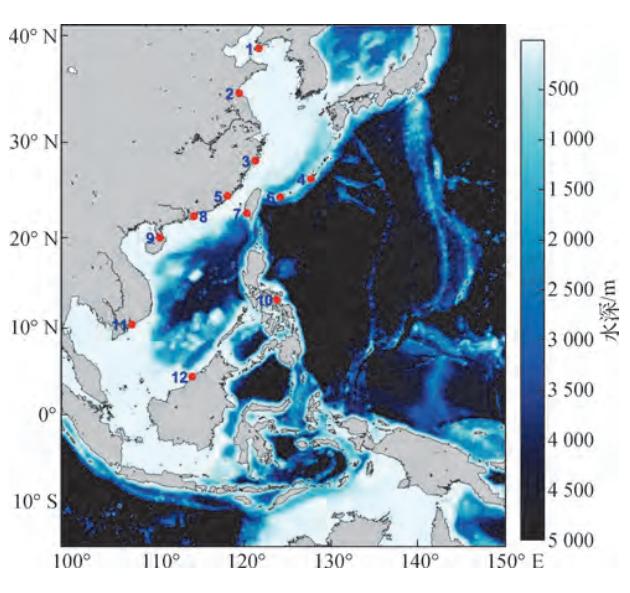
Now, researchers from Xiamen University’s College of Ocean and Earth Sciences and the 715th Research Institute of China State Shipbuilding Corporation Ltd. have published (DOI: 10.6043/j.issn.0438-0479.202412018) a comprehensive numerical study on this topic in the Journal of Xiamen University (Natural Science) in May 2026. Using the Regional Ocean Modeling System (ROMS), the team simulated barotropic tidal motion over a domain spanning 99°E–150°E and 15°S–41°N at a horizontal resolution of 0.05°, with 50 vertical layers and 15 tidal constituents. The domain includes the Bohai Sea, Yellow Sea, East China Sea, northern South China Sea, and adjacent western North Pacific. Their analysis compares Eulerian residual currents, tidal Stokes drift, and Lagrangian residual currents and identifies the mechanisms that govern them.
The simulations reveal distinct regional patterns. In the Bohai Sea, a large anticyclonic (clockwise) residual circulation dominates, with velocities of 0.5–3 cm/s, except in the northern Bohai Strait, where velocities can reach 4–10 cm/s. The Yellow Sea contains several small cyclonic and anticyclonic residual circulations near the coast, while a southward residual current emerges from the Bohai Strait and extends along the central Yellow Sea. In the Taiwan Strait, residual currents flow predominantly northeastward, with a strong anticyclonic circulation around the Taiwan Bank. The study also shows that tidal Stokes drift is comparable in magnitude to Eulerian residual currents in shallow waters but negligible in deep waters. Consequently, Lagrangian residual currents in shallow regions are directed more strongly toward the coast and are slightly faster than their Eulerian counterparts, whereas the two are nearly identical in deep waters.
The high-resolution results also show that bathymetric features such as coastlines, islands, shoals, and submarine ridges organize the residual-current field and generate numerous small-scale circulations. A residual-vorticity balance indicates that the interaction of bottom friction with velocity shear exerts the dominant control on the overall distribution of Eulerian residual currents. The bottom-friction term associated with water-depth gradients acts mainly in localized regions, while the Coriolis term influences the background residual vorticity and several regional structures.
These findings are relevant to coastal management and environmental protection because tidal residual currents contribute to the long-term transport and dispersion of pollutants, sediment, nutrients, and other suspended material. Previous estimates cited in the study indicate that tidal residual currents account for about 50–80% of the local flow between the Changjiang Estuary and the Subei Shoal and may become the dominant component in some shallow coastal areas. The results can inform coastal environmental assessment, marine engineering, channel maintenance, and the sustainable use of coastal resources. By clarifying where tidal residual currents are strongest and which mechanisms shape them, the study provides a physical basis for assessing long-term material transport across China’s continental shelves.
References
DOI
10.6043/j.issn.0438-0479.202412018
Original Source URL
http://dx.doi.org/10.6043/j.issn.0438-0479.202412018
Funding information
National Natural Science Foundation of China (Grant No. 41776015)
National Key Research and Development Program of China (Grant No. 2022YFF0801404).
About Journal of Xiamen University
Journal of Xiamen University (Natural Science), first published in 1926, is a bimonthly journal sponsored by Xiamen University and supervised by the Ministry of Education of China. It publishes original research, reviews and short communications across all natural science disciplines. Indexed in major databases and the World Journal Clout Index (WJCI) Report since 2021, the journal has received numerous awards, including the National Outstanding Science and Technology Journals Award and consecutive selections as a model journal by the Chinese University Science and Technology Journal Society (2016–2024). Its short video abstract initiative was recognized as a case of excellence in science communication in 2024.
Chuanlink Innovations, where revolutionary ideas meet their true potential. Our name, rooted in the essence of transmission and connection, reflects our commitment to fostering innovation and facilitating the journey of ideas from inception to realization.
Related Link:
http://chuanlink-innovations.com
—
For the original version of this press release, please visit 24-7PressRelease.com here
Legal Disclaimer: The content on this page is syndicated from independent third-party providers. Kyrion Media makes no warranties or representations regarding the accuracy, completeness, legality, or reliability of the information, including text, images, videos, or licenses. If you are affiliated with this content or have any complaints, copyright concerns, or requests for removal, please contact us at retract@kyrionmedia.com with the specific URL of the content in question. We will review and address valid requests promptly.